
Current Events
Floating the Ozark National Scenic Riverways on a welcome weekday escape

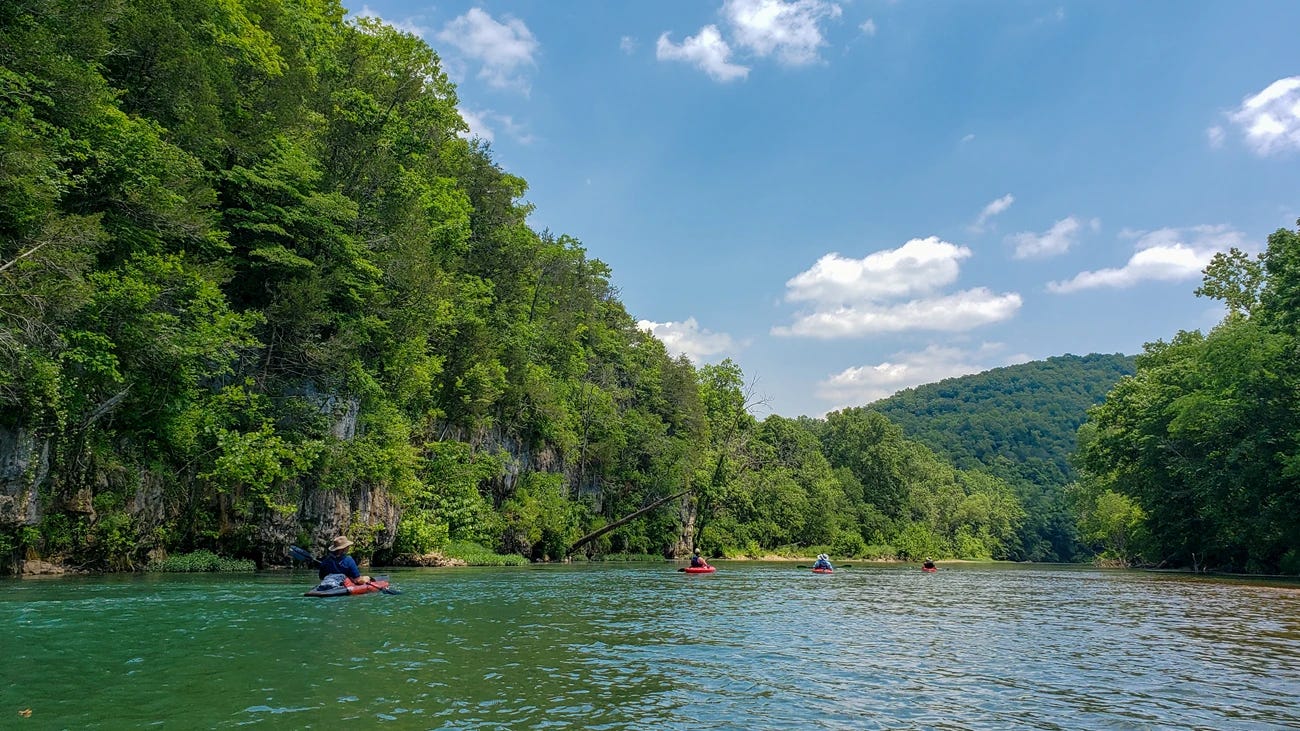
The pressures of contemporary America occasionally require an escape valve, and in our younger days, my wife and I often turned to Missouri’s many floatable rivers as a respite from life’s stressors. (We also indulged in more adrenalizing water trips on our vacations to the West, rafting – with guides – on such wild Class III or IV rivers as the Kicking Horse in British Columbia and the Lochsa in Idaho.) Sadly, the rigors of paddling in a canoe or raft for a full day challenge our increasingly decrepit 70-year-old bodies, but we look back fondly on our float trips.
With canoeing season now upon us, I’m dusting off an essay on weekday floating that I wrote for a special section of The Riverfront Times in the mid-1990s. For readers with better backs than ours, I encourage a visit to the Ozark National Scenic Riverways, especially for a restful weekday trip.
Floating.
Even the word suggests quietude and languor, ease-taking and the most effortless of activities.
To float: to drift lazily and without firm direction, to sit lightly atop the water and move with the gentle, nearly imperceptible current.
To simply be and not to do.
So why, when the attractions of real leisure, of true relaxation, are so clearly and powerfully magnetic, do we insist on carrying the city’s bustle and freneticism into the country? Instead of becoming immersed in the surrounding natural splendors of Missouri’s Ozark waterways and taking pleasure in the scenic wonders they offer, we impose ourselves and our citified ways on them, supposedly bringing our own fun. “Floating,” to many if not most, is thus less verb than adjective – a modifier of “party.”
Float trips, in this (to my curmudgeonly mind) perverted sense, require a flotilla, an armada of canoes often lashed together in an unwieldy barge-like mass and inevitably manned by loud rowdies, fueled by brew, and propelled by boom boxes cranked to 10. In search of a beer-commercial-defined good time, folks on such outings seek stimulation, not solitude, a quickening of the pulse, not quiet, and less hedonistic canoeists who share the river with them are essentially compelled to subordinate any interest in wildlife to others’ wild times. Their hoots and whoops of usually inebriated joy, shouts of “ramming speed!,” the noisy splash of overturned canoes, and the insistent blast of high-volume music rudely shatter the natural serenity and chase frightened animals from their bank-side homes.
Now, everybody loves a party. But why travel all those southerly miles to engage in behavior just as well or better suited to the backyard swimming pool and deck (where only the neighbors will be annoyed)?
Democracy has its price, however, and since no one group has any more right to a river than the next, Missouri’s streams have largely become the province of boisterous yahoos more interested in carousing than canoeing. Float trips, once an escape from the city, have become a mere extension of it.
But only on weekends.
If you’ve given up on floating, implicitly ceding the waters to the bullying loudmouths, weekday trips offer a pleasing alternative to abstinence. No noisome crowds, no peace-disturbing cacophony. Just the river, its wild inhabitants, and you.
A recent two-day, 29-mile float on the Current River – about a three-hour drive southwest on I-44 to St. James and south on Highways 68 and 19 to Round Spring – vividly illustrates the differences between weekday and weekend river visits.
Departing from St. Louis at a reasonable hour on Thursday morning – this was a brief vacation, after all, and early rising wouldn’t do – my wife and I arrived at our outfitter’s in early afternoon. By the time we had traveled by van to our put-in site and secured our gear (cooler and plastic-bagged tent, sleeping bags, foam pads, and duffel) with rope, it was almost 2. However, since only 10 or 11 of our full 29 miles had to be completed the first day, we set off knowing that four hours of leisurely paddling would be all that was required. And rather than launching our craft amid wave after wave of other canoes, as we would have on a Saturday or Sunday, we began this journey in splendid isolation.
On a typical weekend float, we spend much of our time digging hard in the water to pass the splashing, yammering masses, hoping for a few half-mile stretches where relative calm prevails and it’s possible to glimpse a turtle or two, necks craned upward, sunning themselves on a fallen tree. But happily, almost miraculously, this trip there was no need to break from the pack, for the river was sparsely populated, and the dozen-odd canoeists we encountered over the two days were unfailingly polite and well mannered.
There is, I suppose, some small danger in floating alone, without the comforting safety to be had in numbers, especially for the novice canoeist. But a two-couple trip, if one is an experienced pair, provides an easy solution and still avoids the usual more-is-better routine. And given that many large groups seem to regard tipping members’ canoes as good sport, traveling solo may actually be a safer, or at least drier, route.
Nor are Missouri’s rivers particularly difficult canoeing. Although accidents, and even occasional fatalities, do occur, most of the area’s streams at normal water levels are at best moderate challenges even to the beginner. (The Current, for example, is ranked as primarily a Class I river, the lowest level of canoeing difficulty.) As a non-swimmer, I am keenly aware of any body of water’s potential harm, but I’m seldom fearful on a Missouri river: A life jacket, common sense, and some basic canoeing skills are sufficient protection.
Yes, there’s a mild but undeniable adrenaline rush when maneuvering through the intermittent swift water, submerged trees, and hidden rocks, but picking a clean line is more an intellectual puzzle than a physical challenge. The “rapids” of Missouri’s rivers require only a bit of careful study – examining water flow and color for a shallow’s rocky brown, the algae green of the deep, or an obstruction’s tell-tale V-shaped rippling – and a short, intense burst of hard paddling after initially positioning the craft along the chosen path. After rounding the first of the river’s trickier bends – and perhaps suffering a few moments of brief, awful panic as the canoe runs sickeningly aground – even the most inept are suddenly expert.
The general ease of Missouri canoeing can be counted as either debit or credit, of course. Serious canoeists or kayakers no doubt find the state’s meandering streams almost laughably elementary, but to the amateur naturalist, more intent on watching the river’s creatures than working the water, the unhurried pace is a considerable part of the experience’s charm. Regrettably, the unrelenting din of crowded weekends drives most animals from the water and its edge. But on this trip, as we slipped silently by, the wildlife remained in plain and splendid view.
Thursday’s quick float, on water that was surprisingly high and wide despite the absence of recent rains, was restful but disappointingly short of sightings: The late afternoon heat had obviously chased most sensible critters into shade. As the sun crept toward the horizon, we belatedly followed suit, angling our canoe onto a rock bar – with a conveniently soft, sandy area for tent-pitching – and settled in for the night. With a small fire of fallen branches sputtering nearby, we gazed up through the tent’s mesh entrance at a sky bright with intensely burning stars.
Up shortly past dawn, we breakfasted and broke camp, easing into the chilly waters around 6. With the mist hanging eerily low on the river and the sun just beginning its slow burn, the wildlife emerged to hunt and frolic. Bank swallows, with their jet-like, curvilinear wings, swooped and darted in uncountable numbers near the darkly pockmarked bluffs, and belted kingfishers and green herons skimmed the river’s surface, searching for a fishy meal. Toward afternoon, other, less traditionally attractive birds made their appearance -- turkey vultures, a squadron of more than a dozen, moving in loose spiraling formation, searching in a widening circle for carrion on which to feast.
Careful attention to movement on the bank was rewarded with fleeting glimpses of an adolescent raccoon drinking at riverside and a pair of young river otters at play in the morning water. And, periodically, family groupings of ducks would swim shyly nearby, disappearing behind an obscuring log only to pop curiously into sight moments later. More ominously, a snake hied occasionally into view, its head held proudly high, like a ship’s prow, as it gracefully knifed through the stream, moving defiantly against the current. And on a short hike to Fire Hydrant Spring, we encountered another and far more dangerous reptile: a small-sized copperhead, basking in a sliver of sunlight on our path.
As we floated, a boon companion joined us for the day. A great blue heron, with his elegantly crooked neck and majestic wingspan, took point for us – or so it, perhaps absurdly, seemed. Serving as our advance scout – at least in my anthropomorphizing imagination – the heron glided smoothly ahead of us throughout the day, resting imperiously in a tree as we followed his watery trail and then launching himself suddenly as we drew near.
His stately presence was a constant reminder, as we approached our take-out point, that for once, blessedly, we had essentially been alone on the river in the wild – companions to animals and not to man.
Follow the great blue: Test the agreeable waters of the weekday float.