
Rounding the Bases
Celebrating the start of the MLB season with a heavy-hitting lineup of baseball films from the 1980s

As a longtime devotee of the St. Louis Cardinals – even while shaping this post, I yelped with delight as catcher Ivan Herrera launched a moon-shot third homer in the series finale against the Angels – I’ve always taken particular pleasure in films about baseball. That fannish enthusiasm dates all the way back to a sleepover at age 7 or 8, when my indulgent Aunt Dude allowed me to push well past my usual bedtime to watch the end of The Winning Team (1952) on TV. An undeniably mediocre and factually impaired biopic of pitcher Grover Cleveland “Pete” Alexander (played by Ronald Reagan with his typical wooden affability), the film nonetheless enraptured me by climaxing with the Cards’ Game 7 victory over the Yankees in the 1926 World Series – the first of the Redbirds’ world championships. I was so massively taken by The Winning Team that I insisted on an immediate second helping when it re-aired the following morning.
My taste eventually improved, but whenever any sort of baseball film – good, bad, or indifferent – surfaced on television, I dutifully plopped down in front of our black-and-white console. My youthful viewing featured a heavy dose of the annoyingly dominant Bronx Bombers and, more weirdly, of actor William Bendix: The Pride of the Yankees, The Babe Ruth Story (Bendix as the Bambino), Damn Yankees, Take Me Out to the Ballgame, Fear Strikes Out, and Kill the Umpire (Bendix again, this time as the ump at risk).
My fascination with baseball films waned somewhat in high school and college, with the notable exception of Bang the Drum Slowly (1973), and I only caught up with such other worthy ‘70s examples as The Bad News Bears and The Bingo Long Traveling All-Stars and Motor Club after they became available in repertory at the Tivoli Theatre. But in the 1980s, during the first decade of my reviewing career, Hollywood offered an impressive lineup of baseball-focused dramas and comedies, and I wrote about most of the best (and, in the case of The Slugger’s Wife, one of the worst) in The Riverfront Times.
Collected here are my reviews of the Murderer’s Row of The Natural, Eight Men Out, Bull Durham, and Field of Dreams. I’m especially fond of Bull Durham – which qualifies as my favorite baseball film – and unreservedly recommend writer-director Ron Shelton’s recent memoir, The Church of Baseball.
The Natural (1984)
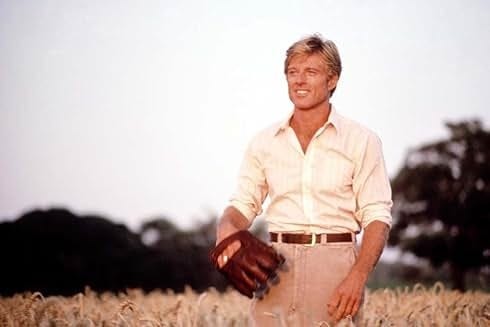
A story plucked from the tall corn – a Capraesque fable of redemption replete with misty eyes and lump-in-the-throat heroics – The Natural is knowing hokum, a benign evocation of our summertime dreams of greensward, sunshine, and bright-white baseballs arcing over distant walls. Unabashedly old-fashioned, The Natural has the visceral, gee-whiz appeal of a home run to the upper deck: It's a nostalgic celebration of baseball's legends and apocrypha that draws deeply at the game's mythopoeic well.
The Natural's story is an exhaustive compendium of baseball lore, and its hero, Roy Hobbs (Robert Redford), is an amalgam of the game’s best, from the Babe to Shoeless Joe. The prototypical “natural,” Hobbs is a southpaw hayseed whose overpowering stuff seems destined to make him “the best there ever was in the game.” Roy, however, is stopped before properly starting: En route to his professional tryout, he is shot by a mad siren and laid low by her trademark silver bullet. A long 16 years later, Roy resurfaces as a 34-year-old rookie and improbably slugs the hapless last-place Knights into September contention. Tempted, but not quite corrupted, by a malevolent quartet of evil plotters – owner, gambler, reporter, and golddigger – Roy must first grapple with an epochal slump before his ultimate salvation at the hands of Iris (Glenn Close), the one good woman, his true love left behind. Eventually – inevitably – Roy stands alone at the plate, the pennant his to win or lose with the season's final stroke.
A stirring tribute to baseball's persistent allure, The Natural unfortunately never fully translates its source’s literary conceits into workable movie equivalents. The characters in Bernard Malamud’s novel are outrageous comic stereotypes deepened and given resonance by Arthurian allusion; these allusions are retained in the film, but the characters remain sadly pagebound – schematic representations rather than full-blooded realizations. The women in Hobbs’ life particularly suffer: Sketched boldly in black-and-white, they fall too neatly into contrasting sinner-saint categories. Hobbs himself fares little better – ever the enigma, he remains an impenetrably mythic figure throughout. Because of this failure to add flesh to metaphoric bones, the abundant acting talent – Redford, Close, Robert Duvall, Richard·Farnsworth, Wilford Brimley – seems criminally underused.
These problems dutifully acknowledged, The Natural nonetheless often delights. The meticulous re-creation of Depression-era baseball by director Barry Levinson, cinematographer Caleb Deschanel, and production designers Angelo Graham and Mel Bourne consistently inspires open-mouthed wonder, and the film’s climactic final reel, with its last-stand at-bat and celebratory explosions, simply inspires.
More solemn, yet less pessimistic, than its novelistic source, The Natural is an adoring valentine to the summer game, a magical tall tale with a simple, compelling message: Play ball.
Eight Men Out (1988)
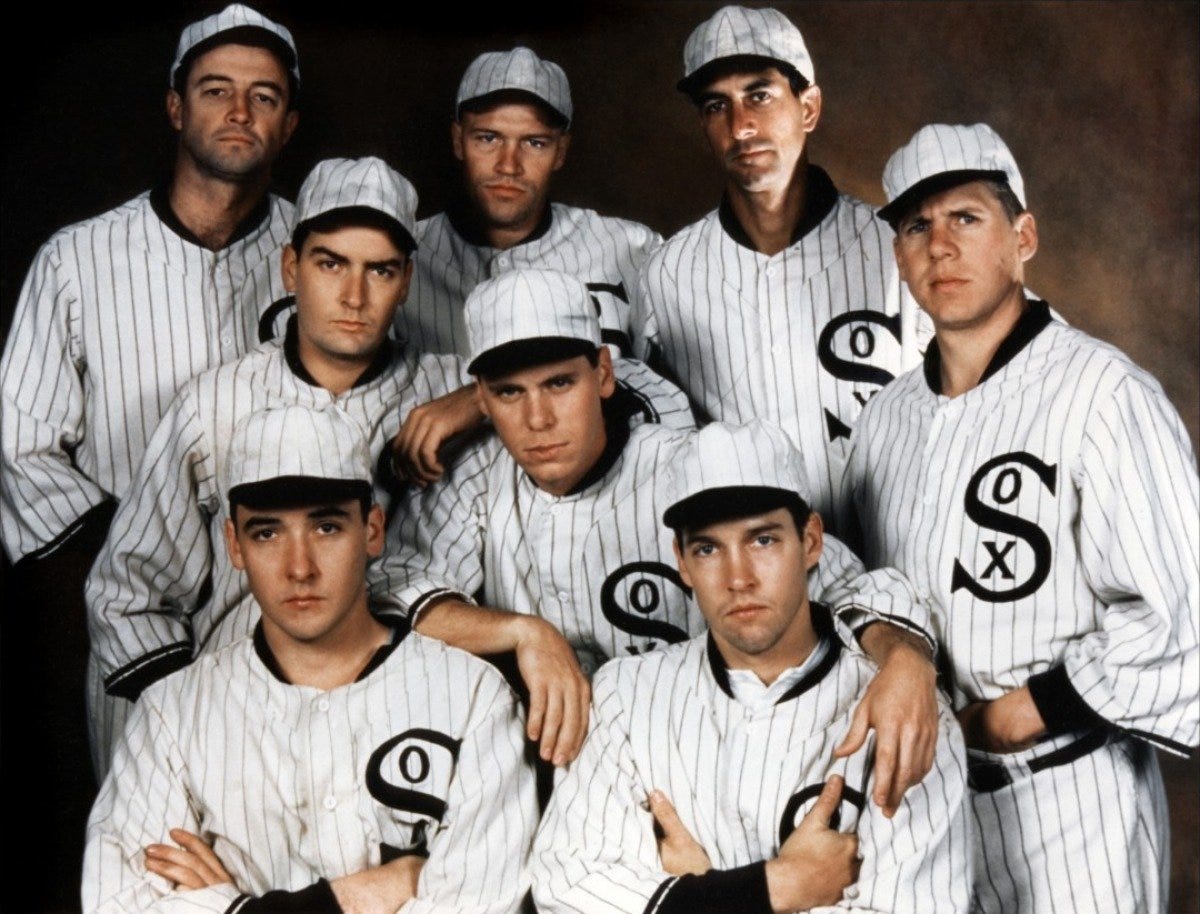
A film of rage and melancholy, of aching, angry sadness, Eight Men Out will likely bewilder the casual fan, whether of baseball or of film, for the movie offers no simple entertainments, no Hollywood happy endings: The uncomplicated thrill of the ball in flight, the neat geometry of the diamond, the bold dramatics of the play afield are subsumed here within the more complex machinations of the larger world – of crime, of business, and of politics. Eight Men Out doesn’t elevate its heroes but brings them low, humanizes the godlike players by afflicting them with mortal failings, greed most especially but also envy, naiveté, and fear. The good guys don’t win in Eight Men Out; we’re not even sure who they might be.
Written and directed by John Sayles and adapted from Eliot Asinof’s baseball classic, Eight Men Out is sadly true, the real-life story of the Chicago White Sox’s dumping of the 1919 World Series. A convoluted tale of cross and double-cross – and the film considerably simplifies the book’s rigorous detail – Eight Men Out bristles with incident and characters: the eight Black Sox involved in the bribery scheme; the manager and team members outside the conspiracy; the three sets of duplicitous gamblers; the penurious owner Charles Comiskey and his front-office underlings; the hardball commissioner Judge Kenesaw Mountain Landis and baseball’s corrupt and petty management officials; the grieving journalists who broke the story; and, finally, the betrayed, unbelieving fans. Sayles, who himself plays journalist Ring Lardner, and his fine ensemble – particularly John Cusack as third baseman Buck Weaver and David Strathairn as pitcher Eddie Cicotte – clearly differentiate these many personalities, giving them surprising definition: Written in shorthand though they are, each of the characterizations is as unique and identifiable as a signature.
Treated as chattel by Comiskey (Clifton James), who was unique only in the degree of his player mistreatment, not his general master-slave philosophy, the Black Sox accepted the gamblers’ bribes out of resentment and arguable need: The grossly underpaid Sox, baseball’s best team, were wholly at the owner’s mercy, subject to his caprices and bound by his edicts. (The inequity of that relationship was not redressed until the 1973 dissolution of the reserve clause, which bound a player to his team in perpetuity, and the creation of free agency. Despite the subsequent enormous jumps in salaries, however, the owners’ recent collusive activities to prevent player movement make any progress appear relative.) The ballplayers were not without blame, of course, and first baseman Chick Gandil (Michael Rooker) and shortstop Swede Risberg (Don Harvey) were particularly culpable. Many of the tainted eight, however, were “guilty” only of gullibility and comradely silence. One of baseball’s immortals, Shoeless Joe Jackson (D.B. Sweeney), an illiterate, easily manipulated naïf, assented to the scheme but played a sterling series, batting .375, slugging .563, scoring five runs and driving in six. Weaver was even more sorely misused: Although aware of the fix, he accepted no money and played hard and well throughout the eight games. Weaver’s stoic refusal to whistleblow cost him his career.
As much a condemnation of capitalistic greed as a story of baseball history, Eight Men Out is unrelentingly dark and profoundly disturbing. It serves as a cautionary tale whose lessons remain hard and pertinent and have yet to be learned.
Bull Durham (1988)
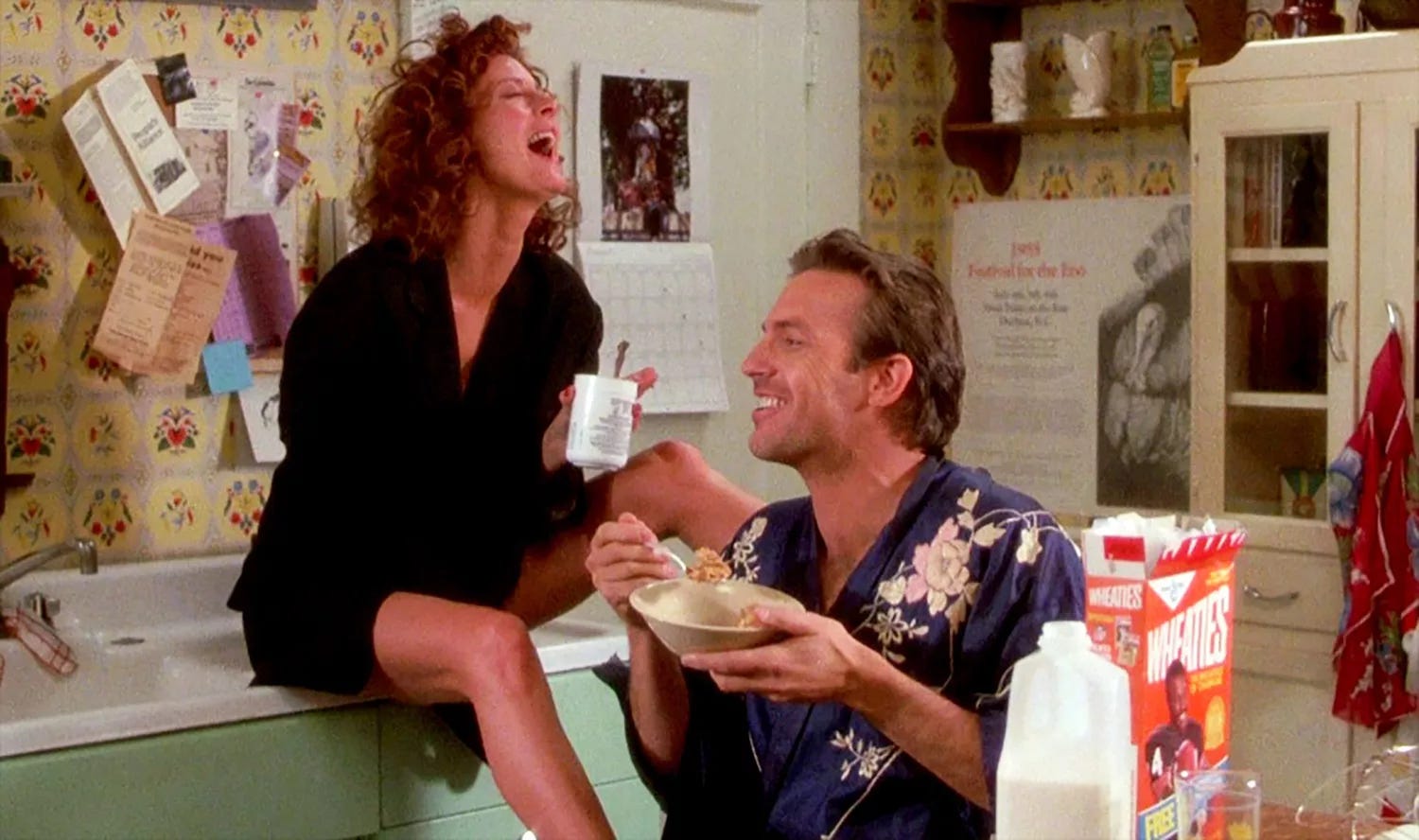
Throwing a winning mix of high-and-tight heat, hardbreaking curves, and the occasional, out-of-the-blue, fooled-you change, Ron Shelton’s Bull Durham keeps us attentive and off balance, slackjawed and slightly overawed by its near-perfection. A rare baseball film that uses the game effectively – and convincingly – as both setting and metaphor, Bull Durham appeals as much to the unconverted as to the devotee: The movie’s interest is less in on-the-field feats of prowess than in baseball’s associated rituals, romantic underpinnings, and larger meanings. Unlike films such as The Natural, which mythologize their heroes, Bull Durham humanizes the sport and restores the connection – in humorously coarse, literal terms – between player and fan. In doing so, it recognizes baseball as a means of attaining maturity while simultaneously prolonging adolescence, establishing a clear relationship between the child’s game and adult life.
Bull Durham differs, markedly, from the usual baseball film by pivoting its story around a woman – Annie Savoy (Susan Sarandon), an acolyte at the sport’s altar, a student of the game, and an instructor in love. An ethereal, highly selective groupie, Annie initially strikes us as somewhat disreputable, a self-admitted star whore, but her personality is considerably more complicated, her motivations more complex and altruistic, than first appearances indicate. Although frankly lascivious, Annie sees sex as both means and end: pleasurable – and desirable – in its own right but also a tool for education, a method of motivation. The ballplayer Annie beds – each season she chooses a promising rookie from the Class A Durham Bulls to teach and inspire – becomes not only her lover but her pupil, helped toward an expanded understanding of the sport and life by her lessons. Annie’s own reward is more transitory, as the men she tutors inevitably, necessarily move on – to higher minor-league designations, perhaps the majors – whereas she remains behind, a dead, pressed flower, now blooming for another, folded in a slim, forgotten book of poetry. To Annie, baseball is romance, the game’s slow rhythms and sudden climaxes a powerfully sexual experience, but her life, like baseball, is in continual flux: Each spring brings fresh, hopeful new faces to fill the long season; each fall the faces – tired, wizened, only rarely exultant – disappear, and the empty winter begins.
In Bull Durham, Annie is confronted with this dichotomy – the attractiveness of eternal renewal versus the hollowness of impermanency – with more directness than usual, forced as she is to choose between two ballplayers who clearly embody the split: Ebby Calvin “Nuke” LaLoosh (Tim Robbins), a youthful, untamed pitcher with a live arm and dead head slated for the bigs, and Crash Davis (Kevin Costner), a career minor-league catcher backpedaling through the farm system on his way to imminent release. Nuke, wild but obviously talented, meets Annie’s prerequisites for tutelage: A future star, he needs considerable polishing to finally shine. In Crash, however, Annie finds a like-minded soul, a fellow teacher. Demoted to Class A specifically to harness and channel Nuke’s considerable energy, Crash is a man among boys, the Bulls’ sage, dispensing practical advice and philosophical direction. Having once sipped his shallow cup of coffee in the majors, Crash inspires respect; having returned to the low minors to sit with a bonus baby, he also serves as a dispiriting example of the game’s hardness, its unforgiving difficulty and impossible demands on body and mind. Crash and Annie spend most of Bull Durham apart, but their mutual experience in educating Nuke and their obvious kinship eventually bring them together and their “careers” to a similar close: They place not the game but the playing behind them.
Rich with humorous detail – much of it undoubtedly culled from writer-director Shelton’s own five-year stint in the Baltimore Orioles minor-league system – Bull Durham works as a comedy not because of exaggeration but verisimilitude. Shelton sometimes takes artistic license for comic or dramatic effect, but the movie looks and feels real – the game action has none of the stiff, unnatural awkwardness of previous baseball films, and the ballplayers themselves are crude, ill-mannered postadolescents with none of the sterile, squeaky-clean falsity of the boyhood idols profiled in sanitized baseball bios. “Get a hit, Crash,” implores the earnest batboy at one point. “Shut up,” is our hero’s blunt and honest reply.
In stripping away the sport’s protective layers of shiny lacquer, Bull Durham finds the bare wood beneath, though rough and slightly discolored, even more attractive: a fine and solid piece of lumber, a well-turned bat of proper heft and lovely taper, full of false promise – a broken squeeze, a lazy fly, a swinging strike three – and exciting possibility – a chalk-skipping rope laced down the third-base line; a hard chop off the plate arcing impossibly upward, spinning suspended for one long frozen moment above the upturned, anxious faces of the infield; a sweet-stroked moon shot rocketing toward the azure heavens, briefly freed of Earth and gravity, bringing the runners ecstatically home.
Field of Dreams (1989)
In his poetic essay collection Fathers Playing Catch with Sons, Donald Hall writes, “Baseball is fathers and sons playing catch, lazy and murderous, wild and controlled, the profound archaic song of birth, growth, age, and death. This diamond encloses what we are.”
Hall’s lyric, meditative appreciation of the game – the game, it could be legitimately emphasized – is echoed, hauntingly, in Field of Dreams. Adapted from W.P. Kinsella’s fabulist novel Shoeless Joe, Field of Dreams will perhaps disappoint some of the book’s more fiercely devoted fans – key alterations and deletions are necessarily made, and in concretizing Kinsella’s dreamy, feather-soft prose, the film adds the drag of reality’s weight, making the story’s conceits less easy to carry. The reader, whose own imaginative power augments the writer’s, shoulders such burdens better than the viewer, who relies solely on the filmmaker’s abilities to visually realize the impossible. Shoeless Joe, with its disembodied voices, ghostly apparitions given new substance, and easy leaps backward on time’s continuum, makes significant demands on reader credulity; Field of Dreams, because we actually hear and see these fantastical events, requires of its audience an even greater suspension of disbelief. Worse still, one of the novel’s quirkiest charms – its use of J.D. Salinger as a principal character – has been lost in screen translation, the victim of either a potential lawsuit or writer-director Phil Alden Robinson’s respect for the reclusive author’s privacy.
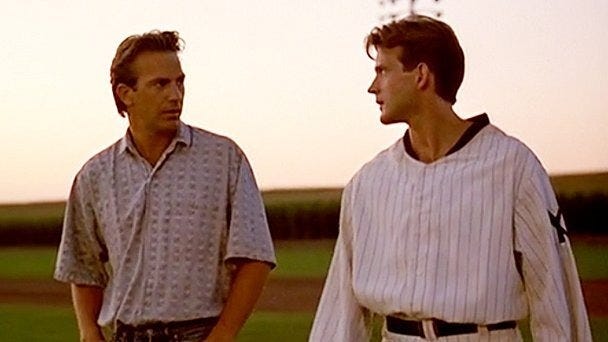
For those unfettered by expectations, however, or for those Shoeless Joe devotees who generously grant Robinson his own creative license, Field of Dreams is a splendid work, frankly and unashamedly sentimental – willing, in the book and film’s own parlance, to “go the distance,” to risk the mawkish and thereby achieve the transcendent. Ray Kinsella (Kevin Costner), once a late-’60s rebel with plenty of cause, now lives a simple life of quietude and seeming joy with wife Annie (Amy Madigan) and pixie-cute daughter Karin (Gaby Hoffman) on an idealized Norman Rockwell picture of an Iowa farm. All appears idyllic bliss until, when working manfully in his cornfield, Ray hears an eerie instruction from above: “If you build it, he will come.” Initially puzzled, and not a little pissed, Ray eventually receives a vision that clarifies the cryptic entreaty – the “it” he’s to build is a ball field; the “he” who’s to come is Shoeless Joe Jackson, the great, tormented star of the “Black Sox,” the eight members of the Chicago White Sox who threw the 1919 World Series and were subsequently expelled from baseball.
Ray, for reasons he himself scarcely fathoms, risks the predations of creditors, clears a section of his farm, erects the field and waits – and when spring finally arrives, Shoeless Joe (Ray Liotta) walks in from the corn and assumes his rightful place on the diamond. Triumphantly, Ray greets his unearthly visitor, his mouth widening into an unbelieving grin when other long-dead ball players join Jackson over the following days to play on his Elysian field. But the “Voice” demands more: “Ease his pain,” it exhorts. And then, “Go the distance.” Chancing financial ruination, Ray pursues the dream, eventually entangling disaffected writer Terence Mann (James Earl Jones) and major-league hopeful Archie “Moonlight” Graham (Frank Whaley/Burt Lancaster) in his mysterious quest.
The hard core around which the plot lines of this baseball yarn are wound – perhaps a touch too tight – is Ray’s conflicted relationship with his late father. John Kinsella (Dwier Brown) – a baseball wannabe whose favorite player was, of course, Shoeless Joe – and son Ray failed to resolve their differences before death made forgiveness impossible (a point that the film, unfortunately, belabors). Field of Dreams, for all its efforts, never quite makes clear what the sticking point was between father and son – Ray is somehow embarrassed by John’s premature age and willingness to abandon his dreams; John is too callused by life to pretend he’s a happy man; Ray’s natural ’60s rebelliousness widens the already-existing generation gap.
Whatever the cause, father and son stopped playing figurative catch early on, and the complicated mystical machinations of Field of Dreams are Ray’s – or some higher power’s – means of renewing the game. For Field of Dreams is principally about baseball as a redemptive force, as a ritual of renewal (it’s set, after all, in a cornfield). The film’s characters represent the ways in which baseball gives pleasure – its aesthetic (Shoeless Joe Jackson), contemplative (Terence Mann), restorative (Archie “Moonlight” Graham), and emotional (John/Ray Kinsella) components – and, through the game, each finds the contentment and purpose he had mislaid: Shoeless Joe again thrills to the grass; Terence picks up the pen after seeing Jackson heft the bat; Archie, having scratched a persistent itch, accepts his fate joyfully and without regret; and Ray and John, warring battery mates, meet on the playing field and find it level. Baseball, a child’s game, encourages the growth of men.
Field of Dreams will strike some as unbearably maudlin, its cornfield a negative symbol of bathetic sentimentality. And the film does have its faults: Annie Kinsella and women generally have no position on its diamond; the threat of Ray losing his farm smacks of melodramatic convention; the ’60s nostalgia occasionally gets as thick and sickening as incense. But Field of Dreams works, its tears earned through sincerity and its mythic ambitions tempered by realism (embodied by Costner’s understated, life-as-lived performance). Field of Dreams realizes that nothing is so elemental in its simplicity as a father playing catch with his son; nor is there an act so complex in its significance or so moving in its effect.