
You're My Boo
An appreciation of the late actor Robert Duvall

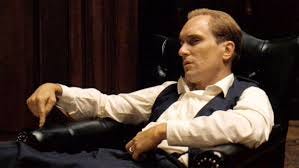
Since Robert Duvall’s death on Feb. 15, dozens of well-deserved tributes to the actor and filmmaker have appeared, and I’m tardy in offering my own nod to his stellar career. Cinephiles are intimately familiar with his best-known roles – in such films as The Godfather, The Godfather Part II, Network, Apocalypse Now, The Great Santini, and Tender Mercies (the lone Oscar win among his seven nominations) and, perhaps most gloriously, in the TV miniseries Lonesome Dove – but his lengthy list of credits glitters with acting gems, from his film debut as Boo Radley in To Kill a Mockingbird to memorable appearances in The Rain People, M*A*S*H, THX 1138, The Great Northfield Minnesota Raid, The Outfit, The Killer Elite, The Seven-Per-Cent Solution, True Confessions, The Natural, Colors, Rambling Rose, Geronimo, Sling Blade, A Civil Action, Open Range, Thank You for Smoking, Broken Trail, We Own the Night, The Road, Get Low, Crazy Heart, The Judge, Widows, and Hustle. Duvall certainly accepted the occasional gotta-pay-the-bills assignment in commercial throwaways (e.g., The Betsy, Deep Impact), but his taste in projects and directors was generally exquisite. He also wrote and directed five of his own films, beginning with the documentary We’re Not the Jet Set in 1974.
Any of the works listed above offer abundant rewards, but I’d like to recommend seeking out a pair of lesser-seen, vastly underappreciated Duvall films. The first, Tomorrow, was one of Duvall’s rewarding collaborations with scenarist Horton Foote, who also wrote the adaptation of To Kill a Mockingbird and the original screenplay for Tender Mercies, with the writer winning Oscars for both. Tomorrow barely received a release when it was made in 1972, but the film was given a second chance in 1983 after the success of Tender Mercies. The second, The Apostle, is an all-Duvall affair – he wrote, directed, and co-executive produced – and it’s a true astonishment. Both of the reviews below originally appeared in The Riverfront Times.
Tomorrow (1972)
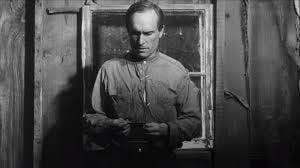
A tender, profoundly moving story told with classical simplicity, Tomorrow has the pure, unaffected honesty of folk art.
Adapted from a William Faulkner short story, Tomorrow is an American independent production originally released in 1972. Although framed by an unnecessarily tricky courtroom drama that makes heavy-handed use of staccato editing and some rather sappy narration, Tomorrow is essentially a spare, two-character set piece, a chaste love story that traces the wary growth of trust between a taciturn cotton farmer (Robert Duvall) and a sickly expectant mother (Olga Bellin) abandoned by her husband. Told as much through gestures – the subtle movements of hands and eyes – as through dialogue, the film unfolds slowly with extended silences, often dwelling for long moments on the faces of the actors and the details of the Depression-era Mississippi rural setting. Modeled on the photographs of Walker Evans, Alan Green’s black-and-white cinematography is as stripped-down and economical as the story. Director Joseph Anthony occasionally employs a too consciously arty composition or effect (a rack focus timed to a thunderclap, for example), but he largely avoids prettification by detailing with sharp clarity the cracked, simple dishes, slivered mirror, hard bed, and plain pine walls that constitute the farmer’s rudimentary home.
Given the central story’s elemental nature, Tomorrow’s effectiveness rests heavily on its principal actors. Duvall’s work is extraordinary, a carefully modulated, uninsistent performance of great force. Animated by a deep-seated inner strength and overpowering love evident in his tentative glances of affection and his troubled face tightened with anxiety. Duvall’s Jackson Fentry burns like a banked fire: The heat is buried but the embers still glow. Bellin is handicapped by infrequent lapses in Horton Foote’s generally careful, apt dialogue – a few passages are regrettably literary and artificial – but her performance is strong and achingly sincere.
An obvious forerunner of Duvall’s work in the recent Tender Mercies, also written by Foote, Tomorrow is a film of quiet power that never overreaches its small, precise ambitions. Tomorrow resembles in its unadorned beauty a tiny, perfect gem placed in a simple setting.
The Apostle (1997)
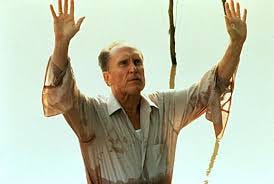
Euliss “Sonny” Dewey, the feverishly animated Pentecostal minister played with fiery brilliance by Robert Duvall in The Apostle, moves with a lightning speed that matches his thunderous oration. He’s so ecstatically wired, so jumped up on God’s higher-power energy, that he keeps breaking into a headlong trot, taking quick-shuffling, herky-jerky jumps instead of steps. It sometimes appears that Sonny is attempting to vault skyward, to rocket directly up the “One Way Road to Heaven” – the name of his church – but he’s weighed down not just by gravity but by grim reality: Sonny’s a wanted man.
Once a well-heeled and respected pastor of a large Texas congregation, Sonny is brought to this low state by a series of misdeeds – most of them his own. An annoyingly single-minded religious obsessive and, despite his spiritual calling, a boozing philanderer, Sonny alienates his long-suffering wife, Jessie (Farrah Fawcett), who takes up with another preacher, Horace (Todd Allen). When Jessie files for divorce and then craftily spirits his church out from under him, Sonny seethes and then explodes, impulsively taking a bat to the head of Horace. Pursued by the police for the assault on his cuckolding (and now comatose) rival, Sonny hightails it, shedding his car, his wallet, and his identity, eventually arriving, seemingly guided by providence, in Bayou Boutte, La., where he assumes the cryptic name of the Apostle E.F. and cajoles the retired Rev. Blackwell (John Beasley) to co-found a new congregation.
After its hugely eventful first act, told in fleet, telegraphic scenes that require us to fill in the blank spaces, The Apostle settles itself a bit in Bayou Boutte, slowing its storytelling rhythms, but Duvall continues to hum with electricity, jolting everyone he meets to vibrant life. Although never entirely repentant – pride, especially, remains his sin – Sonny nonetheless works toward redemption, painstakingly building his tiny church with radio spots and glad-handing, welcoming both black and white, old and young, and bringing them together in joyous celebration. A hypocritical, deeply conflicted man, Sonny wins us over along with his new congregation: Whatever his flaws, Sonny’s preaching legitimately inspires.
And preaching is at the wildly beating heart of The Apostle: the kind of rousing, crazy-eyed evangelism that sweeps the audience up in its rushing current of shouts and hypnotically chanted phrases, carrying them unbidden into frenzy. You don’t even have to believe: The grand performance is enough. Duvall, who also wrote and directed The Apostle, makes Sonny an irresistibly charismatic character, a man to whom you surrender, but the movie keeps just enough distance – it’s a parallax view – for us to recognize the narcissistic, selfish, manipulative impulses that complicate his personality. In one of the opening scenes, Sonny excitedly pulls off the road at a highway accident, creeps into the field where one of the cars involved has come to rest, pokes his head into the driver’s window, and begins to preach to the bleeding, shell-shocked victims. Is this an act of mercy or of monumental hubris? The Apostle refuses to choose one answer over the other, for Sonny himself never quite separates altruism from egotism.
Like Sonny, The Apostle doesn’t achieve perfection. The film tries our patience on occasion with its extended documentary-like passages of unvarnished preachment; these long caesuras effectively stop the story and turn the theater row into a pew, the audience into a congregation. Duvall also seriously missteps with a subplot involving Billy Bob Thornton as a racist who objects to the Apostle’s integrated church. Not only is the troublemaker – that’s actually how he’s identified in the press kit – a largely unmotivated character, but his conversion, which is treated as a major set piece, is the least realistic, most melodramatic moment in this otherwise highly believable, beautifully restrained film.
None of that, however, dilutes The Apostle’s power to move and provoke us. An extraordinary window into a subculture with which most of us have little contact or sympathy, the film illuminates that world and reveals its wonders, with Duvall’s Sonny lighting the way with the incandescence of the Holy Ghost’s tongue of flame.